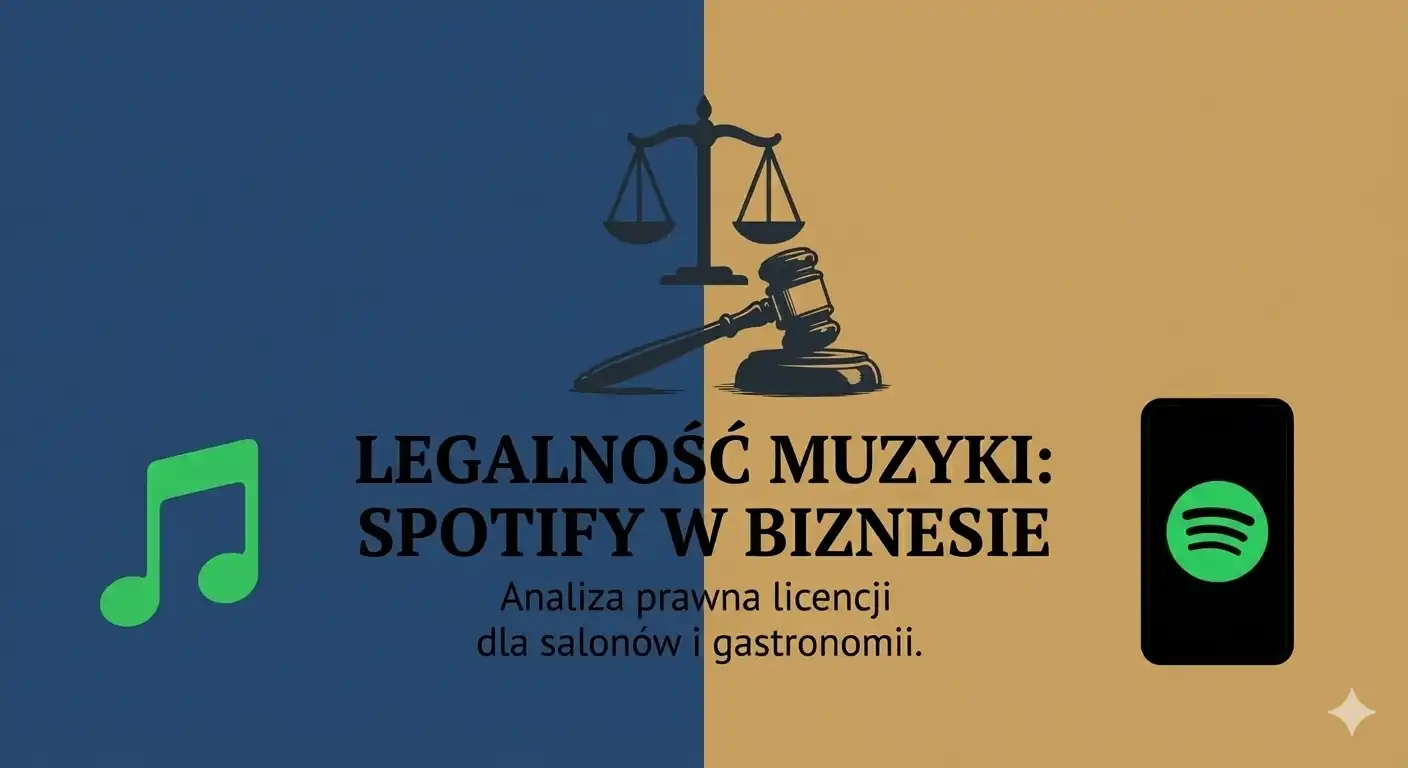

You have a Premium account, so you think you can play playlists in your salon? Unfortunately, copyright law and the terms of service of streaming platforms are unforgiving. Find out why "music from your phone" could land you a fine, and how to do it legally.
I often encounter this line of reasoning from business owners: "I pay a monthly fee for Spotify/Tidal/Apple Music Premium, so I have the right to use that music however I like."
As a lawyer, I have to pour cold water on that idea: This is one of the most common and most dangerous myths in the Beauty industry. Paying a subscription fee does not protect you from an inspection, and in fact it exposes you to a double problem: one from the streaming service itself, and another from collective rights management organisations (CMOs).
Let's break this down step by step, based on the letter of the law, but in plain English.
Problem 1: The Platform's Terms of Service (What Are You Actually Paying For?)
Let's start with the agreement you enter into when you click "I Agree" while creating an account on Spotify or YouTube Music. Every one of these platforms includes a "Personal Use Only" clause in its terms of service.
What does this mean in practice? The licence you purchase for your monthly fee is a private licence. You may listen to music at home, in your car, on a walk. But the moment you play it at a place of business (a salon, waiting room or reception area), you are in breach of your agreement with the service provider.
Technically, the streaming service could suspend your account for violating its terms. But that is the least of your problems.
Problem 2: Public Performance (Where PRS Comes In)
UK copyright law (the Copyright, Designs and Patents Act 1988) distinguishes between private listening and public performance.
According to established legal interpretation, if music played in a commercial venue increases the attractiveness of the services or enhances the experience for customers (which is undoubtedly the case in a hair salon or spa), this constitutes a public performance for commercial purposes.
This is where collective management organisations (CMOs) such as PRS for Music and PPL come in. They represent composers, performers and producers.
Why doesn't Spotify pay PRS/PPL on your behalf? Spotify pays royalties only for private listening. It does not remit fees for public performance in commercial premises. Therefore, if you play radio or Spotify in your salon, you must additionally sign agreements with PRS and PPL and pay them a separate licence fee (often calculated based on the size of your premises and the number of people present).
To summarise:
- You pay Spotify (for a personal account).
- You must also pay PRS for Music and PPL (for public performance).
- Result: You pay twice, and you're still in breach of Spotify's terms of service.
The Legal Solution: Direct Licensing Music (SoundYou)
Can this be done legally? Yes. Copyright law allows creators to manage their rights directly, bypassing CMOs. This is the so-called Direct Licensing model.
This is precisely the model on which SoundYou is built.
How does it work legally?
- As SoundYou, we are the producer of the music or hold exclusive economic copyright to it.
- Our music is not registered with any CMO (PRS, PPL, etc.).
- We grant you a direct licence for public performance at your premises.
This keeps the legal chain short and clean: Creator (Us) → Licence → Your Salon.
The Certificate: Your Shield During an Inspection
When you use SoundYou, you receive a Certificate of Legality. This is a legal document you can present to an inspector if they ask: "Why aren't you paying a PRS/PPL licence?"
The certificate proves that:
- You are playing music from a legal source.
- You have the rights holder's permission for public performance.
- The works are not managed by any CMO, so the inspector has no grounds to charge a licence fee.
The Legal Verdict
Using a personal Spotify account for business purposes is a legal grey area that is, in reality, a red zone. You are exposed to claims for unpaid fees going back up to 6 years (plus interest), as well as penalties for copyright infringement.
If you want to sleep soundly at night and avoid paying multiple organisations, choose a solution designed specifically for business use. It's not just a matter of saving money: it's about the legal security of your company.
Take care of the legal side of your business. Choose music with a Certificate: See the SoundYou business offer